
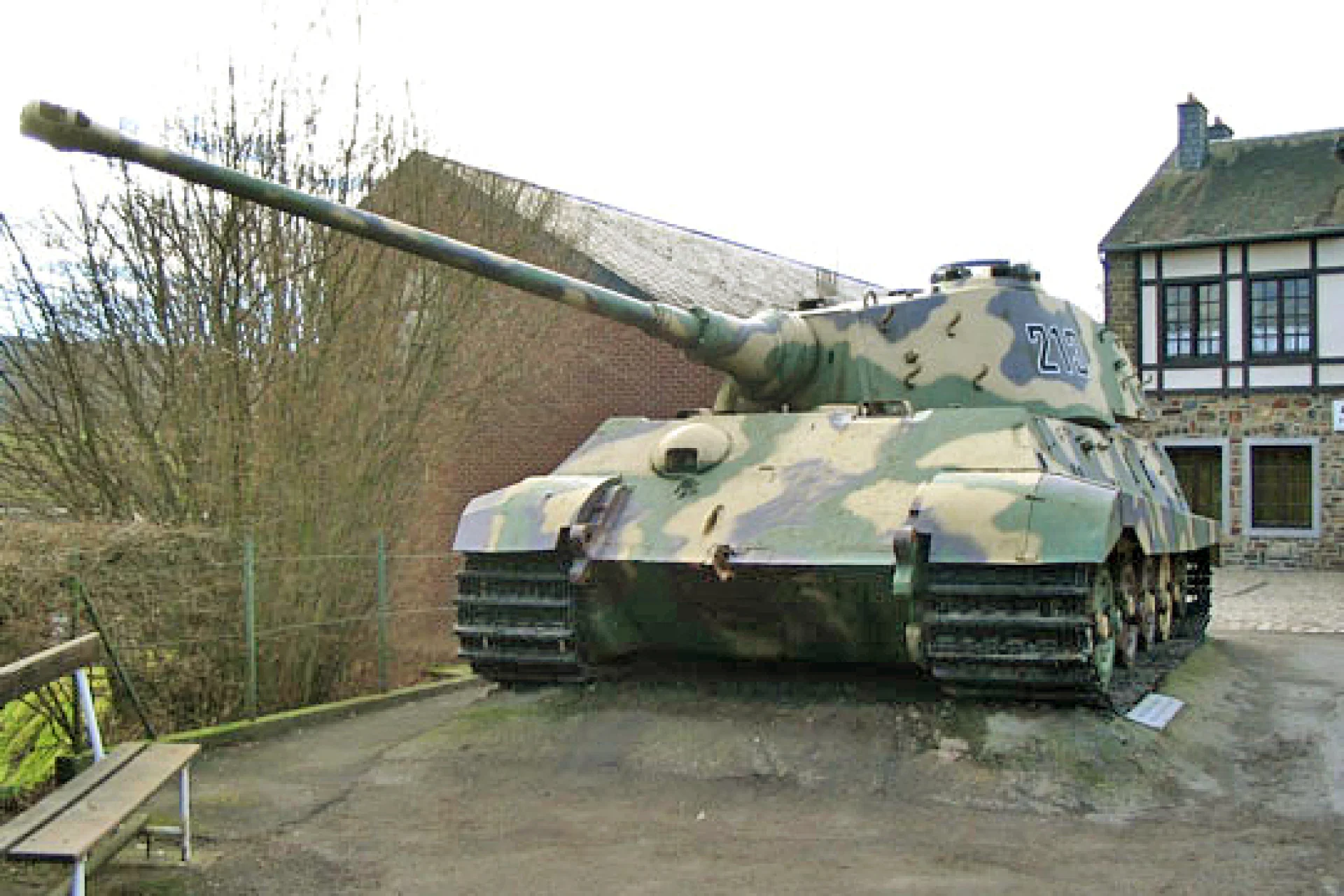
 Photo: Poldiri / Wikimedia Commons / License: CC BY-SA 3.0
The Panzerkampfwagen VI Tiger II, often known as the King Tiger, represents the pinnacle of German heavy tank design during World War II, a formidable weapon that instilled fear among Allied forces. The specific example preserved in La Gleize, Belgium, is a potent relic from the desperate fighting of the Battle of the Bulge, a stark reminder of the conflict's intensity and ultimate human cost.
Deployed late in the conflict, the Tiger II was designed to be the ultimate heavy tank, combining exceptional firepower with impenetrable frontal armor. Its formidable 8.8 cm KwK 43 L/71 main gun could penetrate virtually any Allied tank at long range, while its thick, sloped armor made it incredibly resistant to enemy fire. Tiger IIs first saw action on the Eastern Front in mid-1944 and later on the Western Front, including during the Normandy campaign and Operation Nordwind.
Its most famous, and ultimately ill-fated, deployment was during the Battle of the Bulge (Ardennes Offensive) in December 1944. Here, Tiger IIs spearheaded desperate German counter-offensives, attempting to break through Allied lines. The La Gleize Tiger II, specifically, was part of Joachim Peiper's Kampfgruppe Peiper, the spearhead of the 1st SS Panzer Division. This unit achieved significant penetration into the Ardennes, but its advance ultimately stalled due to a lack of fuel and fierce Allied resistance. On December 18, 1944, surrounded and out of fuel, Peiper's men were forced to abandon their heavy vehicles, including this Tiger II, near La Gleize, and retreat on foot. While immensely powerful, the Tiger II suffered from mechanical unreliability, high fuel consumption, and the overwhelming logistical challenges faced by the German army in the war's final stages. Its destructive potential was often curtailed by these practical limitations.
The Panzerkampfwagen VI Tiger II remains an iconic symbol of World War II armored warfare, a testament to ambitious German engineering and the brutal realities of late-war combat. Its advanced design elements, particularly its sloped armor and powerful gun, influenced post-war tank development. However, its high production cost, slow speed, and mechanical issues ultimately limited its strategic impact.
Today, the Tiger II at La Gleize is one of the most significant and well-preserved examples of this rare machine. It stands prominently outside the December 1944 Historical Museum, a powerful, silent witness to the savage fighting that engulfed the Ardennes. Visiting this imposing tank allows one to grasp the sheer scale of WWII technology and reflect on the tremendous sacrifices made by all sides in that devastating winter campaign. It serves as a tangible link to the human stories of courage, despair, and resilience etched into the Belgian landscape.
Plan your World War II trip with guides to museums, battlefields, memorials and historic sites worldwide. Discover the best WWII locations for your next tour.