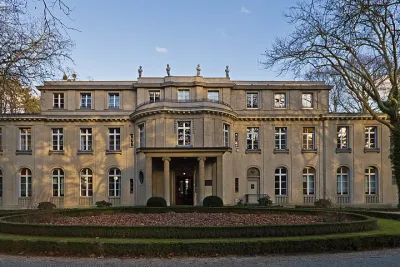
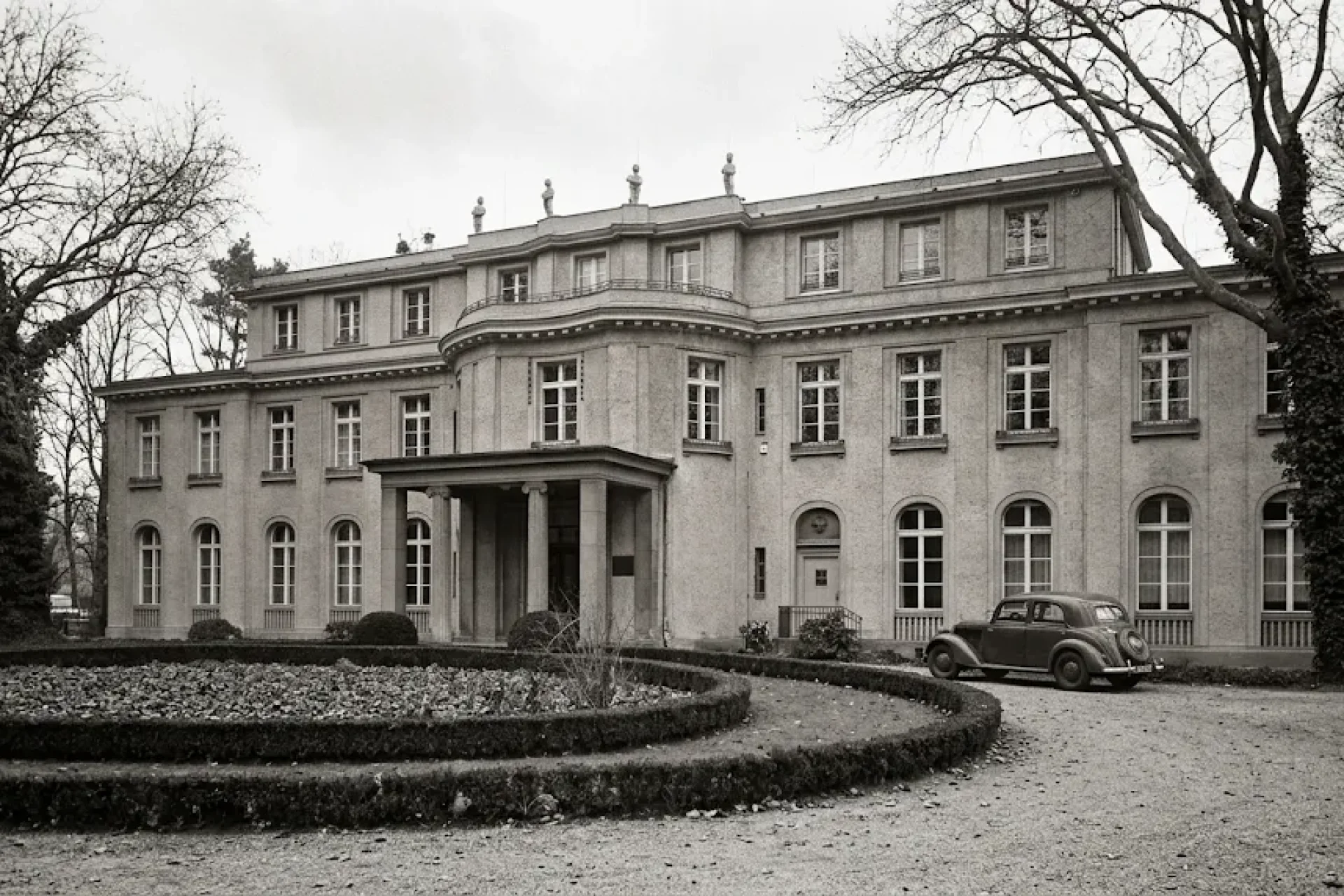
The Wannsee Conference, held on January 20, 1942, was a pivotal meeting of senior Nazi officials where the administrative and logistical framework for the “Final Solution to the Jewish Question” (Endlösung der Judenfrage) was coordinated. Lasting only about 90 minutes, this chilling gathering aligned the German state bureaucracy with the SS to execute the systematic genocide of European Jews, marking a decisive turning point in the Holocaust.
Originally scheduled for December 9, 1941, the meeting was postponed following the Japanese attack on Pearl Harbor and Germany's declaration of war on the United States. When the fifteen men finally convened in the dining room of the lakeside villa at noon on January 20, 1942, the decision to annihilate the European Jews had already been made by Adolf Hitler.
Chaired by Reinhard Heydrich, Chief of the Reich Security Main Office (RSHA), the meeting had two primary objectives:
During the meeting, Heydrich presented a statistical breakdown of approximately 11 million Jews across Europe—including neutral countries like Switzerland and Sweden, as well as the United Kingdom—as targets for the operation. The participants discussed deporting Jews to the occupied East for forced labor under lethal conditions ("destruction through work") and the immediate murder of those deemed unable to work. Further debate focused on the definition of "Mischlinge" (persons of mixed Jewish and non-Jewish ancestry) and exemptions for certain groups, such as decorated World War I veterans.
Following the official session, the participants stayed for lunch and cognac, casually discussing the implementation of mass murder. Adolf Eichmann, head of the RSHA’s Jewish Affairs department, took the minutes, later editing them under Heydrich’s supervision to use euphemistic bureaucratic language ("evacuation to the East"). Of the 30 copies produced, only one survived—discovered in 1947 in the files of the Foreign Office.
The attendees were not merely ideological fanatics; many were highly educated civil servants, eight of whom held doctorates. They represented the intersection of the SS police apparatus, the Nazi Party, and the traditional German state administration:
| Name | Title / Rank | Organization / Ministry Represented |
|---|---|---|
| Reinhard Heydrich | SS-Obergruppenführer | Chief of the Security Police and SD (RSHA) – Chair |
| Dr. Josef Bühler | State Secretary | Office of the General Government (Occupied Poland) |
| Dr. Roland Freisler | State Secretary | Reich Ministry of Justice |
| Otto Hofmann | SS-Gruppenführer | Head of the SS Race and Settlement Main Office (RuSHA) |
| Dr. Gerhard Klopfer | SS-Oberführer | Party Chancellery (NSDAP) |
| Friedrich Wilhelm Kritzinger | Ministerial Director | Reich Chancellery |
| Dr. Rudolf Lange | SS-Sturmbannführer | Commander of the Security Police and SD in Latvia |
| Dr. Georg Leibbrandt | Reichsamtsleiter | Reich Ministry for the Occupied Eastern Territories |
| Martin Luther | Undersecretary of State | Foreign Office (Auswärtiges Amt) |
| Dr. Alfred Meyer | Gauleiter & State Secretary | Reich Ministry for the Occupied Eastern Territories |
| Heinrich Müller | SS-Gruppenführer | Chief of the Secret State Police (Gestapo) |
| Erich Neumann | State Secretary | Office of the Plenipotentiary for the Four-Year Plan |
| Dr. Karl Eberhard Schöngarth | SS-Oberführer | Commander of the Security Police and SD in the General Government |
| Dr. Wilhelm Stuckart | State Secretary | Reich Ministry of the Interior |
| Adolf Eichmann | SS-Obersturmbannführer | Head of Referat IV B4 (Jewish Affairs), RSHA – Recording Secretary |
Today, the villa operates as the House of the Wannsee Conference Memorial and Educational Site (Gedenk- und Bildungsstätte Haus der Wannsee-Konferenz). Visitors can walk through the historic rooms—including the former dining room where the conference took place—experiencing the stark contrast between the tranquil lakeside setting and the bureaucratic horror planned inside.
Plan your World War II trip with guides to museums, battlefields, memorials and historic sites worldwide. Discover the best WWII locations for your next tour.