
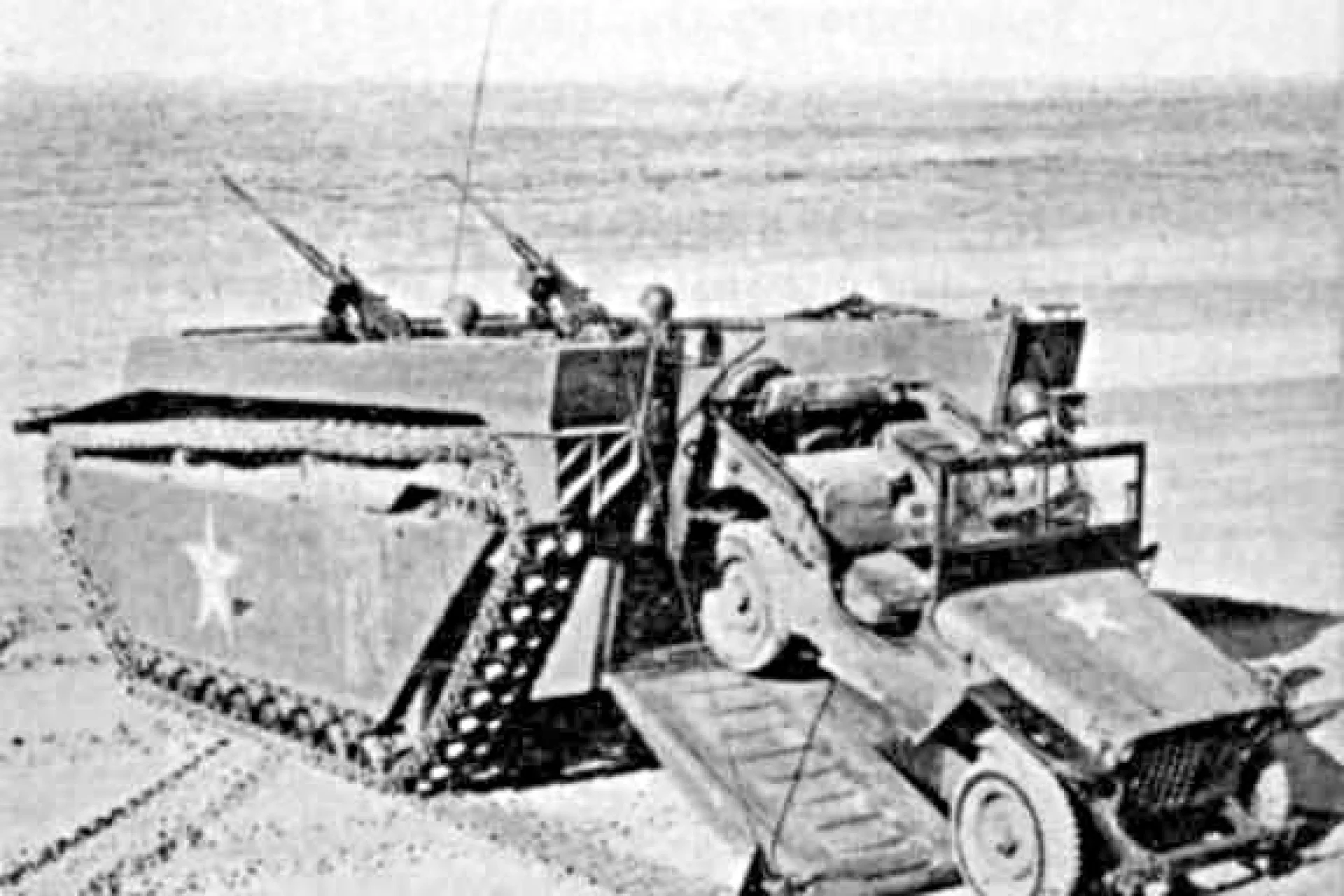
The LVT (Landing Vehicle Tracked), often dubbed the "Amtrac," was a pivotal amphibious vehicle instrumental in Allied assaults across World War II, enabling troops and supplies to transition seamlessly from sea to shore under enemy fire. Its innovative design bridged the crucial gap between naval transport and land combat, profoundly shaping the tactics of island-hopping campaigns and river crossings.
Key Facts:
The LVT’s journey began with a civilian rescue vehicle concept, swiftly repurposed for military use as the United States entered World War II. Its most defining role was in the crucible of the Pacific Theater, where the vast distances and numerous heavily fortified islands demanded a vehicle capable of navigating treacherous coral reefs and delivering fighting troops directly onto enemy beaches. Early models, like the LVT-1 and LVT-2, were primarily cargo and troop carriers, essential for the initial waves of amphibious assaults.
The Battle of Tarawa in November 1943 starkly underscored the LVT's indispensability. Without these "Alligator" vehicles, countless Marines would have been stranded or drowned in the shallow waters, unable to traverse the coral defenses. The experience led to rapid improvements, including increased armor and, crucially, dedicated armored fire support variants like the LVT(A)-1 and LVT(A)-4, armed with cannons and howitzers. These armored LVTs provided vital close-in fire support, suppressing enemy positions as infantry advanced, greatly reducing casualties and speeding up beachhead consolidation. The LVT was central to every major amphibious operation in the Pacific, from Guadalcanal to Iwo Jima and Okinawa, embodying the sheer grit and innovative spirit of the Allied forces.
Beyond the Pacific, LVTs also saw significant action in the European Theater. Their amphibious capabilities proved invaluable during river crossings, notably in the Scheldt Estuary during the push towards Antwerp and the audacious Rhine River crossings in 1945. They allowed Allied forces to overcome natural water obstacles, maintaining momentum against German defenses. While relatively lightly armored and vulnerable to direct anti-tank fire, the LVT's ability to bridge the land-sea divide was unmatched, saving countless lives and critically contributing to the Allied victory.
The LVT's legacy is etched into the annals of amphibious warfare. It revolutionized assault tactics, proving that troops could be delivered directly to shorelines over difficult terrain, even under fire. Its success laid the groundwork for future amphibious vehicle development and remains a testament to the urgent ingenuity born from wartime necessity. The LVT's contribution is honored not just in military history texts but also in the poignant stories of the service members who rode them into battle.
Today, surviving examples of various LVT models are preserved in museums worldwide, serving as tangible reminders of their crucial role. Notable places to see an LVT include:
Plan your World War II trip with guides to museums, battlefields, memorials and historic sites worldwide. Discover the best WWII locations for your next tour.