
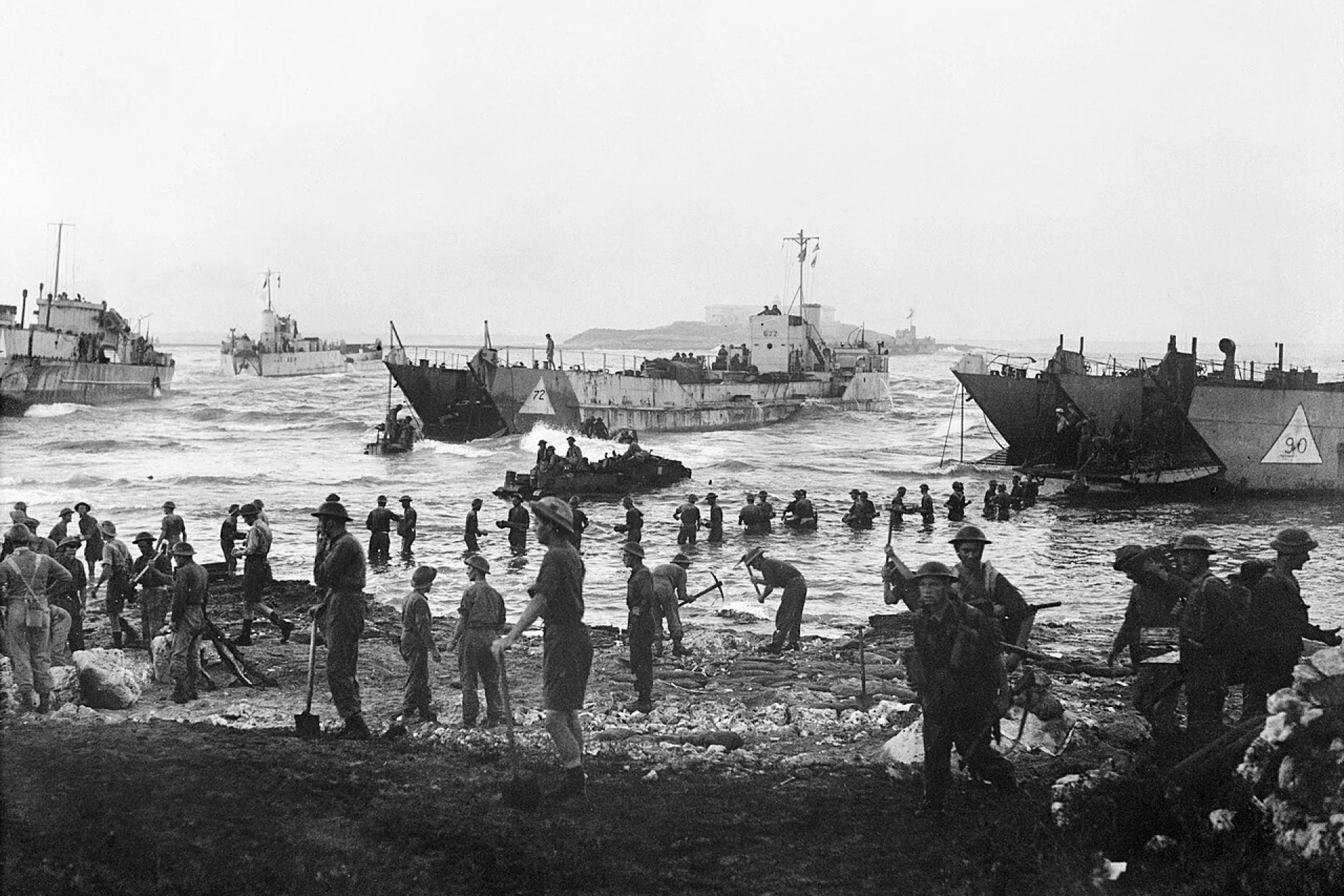
Operation Husky, the Allied invasion of Sicily in July 1943, marked the beginning of the liberation of Italy and was the largest amphibious operation of World War II to date. This monumental campaign profoundly shaped the course of the war, drawing significant Axis resources and hastening the fall of Mussolini's fascist regime.
Key Facts:
Following the Allied triumph in North Africa, the strategic focus shifted to the "soft underbelly" of Europe: Italy. Operation Husky was meticulously planned, aiming to seize Sicily, a vital stepping stone in the Mediterranean. On July 10, 1943, under the command of General Dwight D. Eisenhower, vast Allied forces launched coordinated amphibious landings along Sicily's southern and eastern coasts. American troops, led by General George S. Patton, landed in the west, pushing towards Palermo, while British and Canadian forces, under General Bernard Montgomery, landed in the east, aiming for Messina via Catania.
The invasion was met with fierce resistance from Italian and German forces, particularly the seasoned German Hermann Göring Panzer Division. Battles raged across the island's rugged terrain, from the initial beachheads to key towns like Syracuse, Catania, and the mountainous approaches to Mount Etna. The civilian population endured immense suffering, caught between the warring armies, with many homes destroyed and lives lost. The brutal fight for the island exposed the strategic complexities and human cost of combined arms warfare.
Despite the stiff opposition, the Allies advanced steadily. The rapid collapse of Italian resistance, coupled with the success of the landings, directly contributed to the political upheaval in Italy, leading to King Victor Emmanuel III's overthrow of Benito Mussolini on July 25, 1943. After 38 days of intense combat, Messina fell to Allied forces on August 17, marking the end of Operation Husky and the complete Allied control of Sicily. This victory not only opened the Mediterranean but also paved the way for the grueling Italian Campaign.
Sicily today offers a poignant landscape for reflection and remembrance of Operation Husky. Visitors can explore battle-scarred landscapes, numerous memorials, and dedicated museums that bring the island's wartime experience to life. Sites such as the Sicily-Rome American Cemetery in Nettuno (though not on Sicily, it holds many reinterred from the initial Italian campaign, including some from Sicily) and the Commonwealth War Graves Commission cemeteries on the island, like the Catania War Cemetery, offer solemn places to honor the fallen. Local museums in towns like Catania, Syracuse, and Palermo feature exhibits with artifacts, uniforms, personal stories, and photographic archives, detailing the Allied landings, the resistance, and the impact on the civilian population. Preserved bunkers, remnants of defensive lines, and monuments dedicated to specific units or battles can still be found across the island, providing tangible links to the events of 1943.
To fully appreciate the scope of Operation Husky, consider dedicating several days to exploring different regions of Sicily. Start by researching specific battle sites or museum locations relevant to your interest, such as those around Syracuse for British landings or Palermo for American advances. Renting a car is highly recommended for flexibility, allowing you to reach more remote historical markers and battlefields. Engage with local guides who can offer invaluable historical context and personal stories. Remember to wear comfortable footwear for exploring varied terrain. For a deeper historical dive, combine your visit with other significant WWII sites in mainland Italy, such as those related to the Salerno landings or the Gustav Line. Always approach these sites with respect, acknowledging the profound sacrifices made by soldiers and civilians alike.
Plan your World War II trip with guides to museums, battlefields, memorials and historic sites worldwide. Discover the best WWII locations for your next tour.