
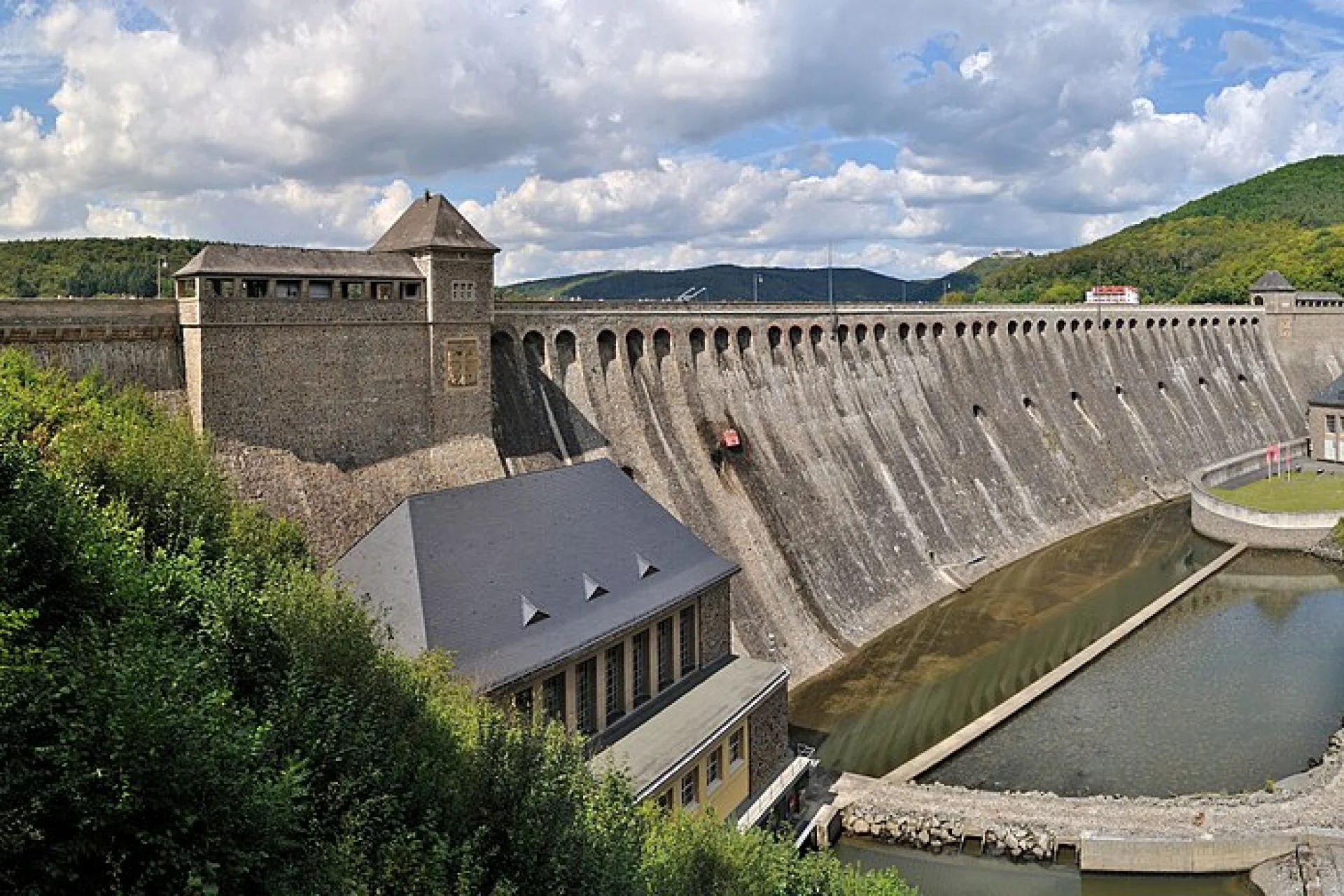
 Photo: kaʁstn / Wikimedia Commons / License: CC BY-SA 3.0
Standing at the base or atop the massive structure of the Eder Dam today, it's easy to be awed by the sheer scale of human engineering. Yet, for those who know its history, this impressive landmark in the heart of Germany whispers tales not just of construction, but of conflict, strategy, and the devastating impact of war on infrastructure and lives. The Eder Dam is more than just a barrier holding back vast waters; it is a tangible connection to one of World War II's most daring and impactful operations.
Built between 1908 and 1914, the Eder Dam was a crucial part of a larger system designed to regulate water levels on the Weser River and supply water to the Mittelland Canal, a vital artery for German industry and transportation. Its primary function was to ensure navigable depths for barges carrying coal, iron ore, and other essential goods, particularly to the Ruhr Valley, Germany's industrial heartland. This made the Eder Dam, alongside the Möhne Dam, a strategically critical asset, essential for sustaining the Nazi war machine. Disrupting its function would not only impact transportation but also hydroelectric power generation, making it a prime target for Allied forces seeking to cripple German industrial capacity.
The Eder Dam gained its indelible place in World War II history on the night of May 16-17, 1943, during "Operation Chastise," famously known as the Dambusters Raid. Led by Wing Commander Guy Gibson of the Royal Air Force's No. 617 Squadron, a specially trained unit, the mission aimed to breach the Eder and Möhne Dams using Barnes Wallis' innovative "bouncing bombs." The raid on the Eder Dam was particularly challenging due to its unique geological surroundings and and its defenses. After several attempts, the dam was successfully breached, unleashing a torrent of water that surged down the Eder Valley, causing widespread flooding, disrupting communication, and impacting infrastructure. While the strategic impact was significant, the human cost was also immense, particularly for forced laborers and civilians in the valley below.
Today, the Eder Dam stands fully restored, a testament to resilience and reconstruction. Visitors can walk across the dam wall, taking in panoramic views of the Edersee (Eder Lake) on one side and the deep valley on the other. A memorial plaque commemorates the Dambusters Raid, allowing for a moment of reflection on the events of that fateful night. The surrounding area offers picturesque landscapes perfect for hiking and boating, but it is the palpable sense of history that truly draws visitors interested in World War II. Interpretive signs offer context, helping to visualize the immense power of the water released and the strategic significance of the structure.
Visiting the Eder Dam provides a unique opportunity to connect with a pivotal moment in World War II. Standing here, you can envision the low-flying Lancaster bombers, feel the tension of the raid, and comprehend the strategic calculations that made this site a target. It's an important stop on any World War II history tour, offering a profound perspective on the complexities of military strategy, engineering innovation, and the far-reaching consequences of conflict. It serves as a powerful reminder of how civilian infrastructure became intertwined with the fortunes of war, and a place to honor all those whose lives were touched by these events.
Plan your World War II trip with guides to museums, battlefields, memorials and historic sites worldwide. Discover the best WWII locations for your next tour.